The Ultimate Guide to Billy Jack Hats: Rebellion, Cinema, and Craftsmanship

Welcome to the ultimate deep dive into one of the most culturally significant, fiercely independent pieces of headwear to ever grace the silver screen: the **Billy Jack Hat**. Whether you are a vintage cinema enthusiast, a lover of rugged Western fashion, or someone who appreciates the deep artistry of custom hatting, this guide explores everything you need to know about the hat that defined a generation of cinematic rebellion.

If you've been searching for authentic, premium-quality **Billy Jack Hats**, understanding what makes this specific silhouette so unique is the first step toward owning a piece of true counterculture heritage. Grab a seat by the workbench, put on your favorite classic soundtrack, and let's unravel the story, the style, and the masterful craftsmanship behind **Billy Jack Hats**.

---

## 1. Introduction: The Hat That Struck a Chord

Some hats protect you from the sun. Others ask people which branch of the military or sports team they support. But a select few hats carry a message so loud, so distinct, that the moment you slip one onto your brow, you aren't just wearing an accessory—you're making a statement.

In 1971, a micro-budget indie film blew the doors off the Hollywood establishment. That movie was *Billy Jack*, starring, co-written, and directed by Tom Laughlin. It followed a half-Navajo, green-beret Vietnam veteran who used martial arts, a deeply rooted moral compass, and an unyielding spirit to protect a progressive alternative school in the Arizona desert from corrupt local townspeople.

Billy Jack became an overnight folk hero. He was a champion for the underdog, a protector of the peace who wasn't afraid to unleash a flurry of hapkido kicks if pushed too far. And his uniform? A denim jacket, a simple pendant, and that undeniably magnificent, imposing black hat.

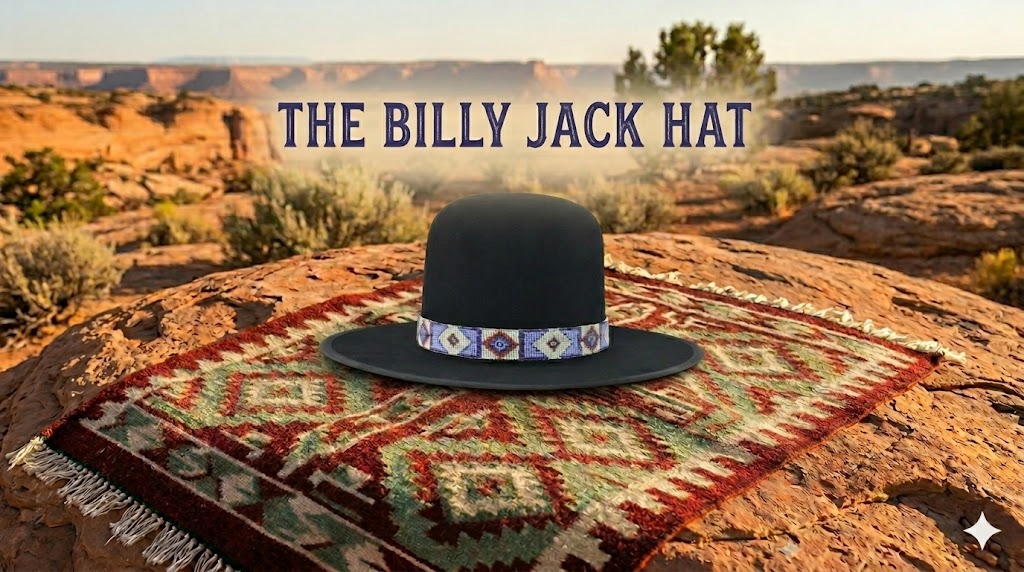
The silhouette was unlike anything else seen in Western cinema at the time. It wasn't a pristine, sharply creased cowboy hat worn by a traditional lawman, nor was it the greasy, beaten-down cap of a standard movie villain. It was flat-brimmed, tall-crowned, and wrapped in a hand-woven Native American-style beaded band. It was a visual symbol of a man caught between two worlds—the ancient wisdom of the frontier and the turbulent socio-political landscape of the 1970s.

Decades later, the legacy of **Billy Jack Hats** remains more potent than ever. Hat aficionados, retro film collectors, and style icons worldwide still seek out high-end reproductions of this legendary headwear. Let's ride back in time to see exactly how this look came to be.

---

## 2. The Birth of an Icon: The History Behind Billy Jack Hats

To appreciate the design of modern **Billy Jack Hats**, we have to take a look at how Tom Laughlin's character upended decades of traditional Western movie costuming.

### Breaking the Hollywood Mold
For the first half of the 20th century, Western movies adhered to a very strict, almost biblical costuming code. The good guys wore bright white hats with high, pinched cattleman creases. The bad guys wore jet-black hats with identical creases. It was an instant visual shorthand designed to make sure the audience never had to think too hard about who they were rooting for.

By the late 1960s and early 1970s, filmmakers began tearing down those rigid structures. Characters became morally complex, anti-heroes emerged, and the wardrobe shifted to reflect this internal grey area. When Tom Laughlin first introduced the character of Billy Jack in the 1967 film *The Born Losers* (before spinning him off into his own self-titled 1971 smash hit), he consciously chose a wardrobe that broke every rule in the book.

### The Influence of the Spanish Campaign and Southwestern Styles
The structural shape of the Billy Jack Hat doesn't actually stem from standard American cattle ranching. Instead, its roots stretch back to the old Spanish colonial settlements of the American Southwest and Mexico, drawing heavily on the traditional *Poblano* hat and the low-profile hats worn by early circuit riders and frontier preachers.

By pairing a stark, unforgiving black felt body with a vibrant, intensely detailed Native American seed-bead hatband, Laughlin created a visual paradox. The hat was imposing, almost menacing at first glance due to its sheer scale and darkness, yet it was softened and humanized by the intricate, colorful craftsmanship surrounding the crown. It perfectly mirrored Billy Jack's character: a deeply spiritual pacifist who was lethal when provoked.

---

## 3. Dissecting the Anatomy of Authentic Billy Jack Hats

What makes a hat a true Billy Jack reproduction rather than just a standard black fedora or an unshaped cowboy hat? It all comes down to the precise metrics of the crown and brim. When looking for genuine **Billy Jack Hats**, keep an eye out for these defining anatomical features:

### The Open, Uncreased Crown
The absolute hallmark of a classic Billy Jack Hat is its crown. Unlike a standard cowboy hat, which features a deep center dent, a cattleman crease, or side pinches, a true Billy Jack crown is left largely **open and round**. It features a tall, slightly tapered cylindrical shape that typically stands between 6" inches in height**. This open-crown design gives the hat an incredibly solid, old-world architectural presence on the wearer's head.

### The Flat, Hand-Flanged Brim
While traditional cowboy hats curve dramatically upwards at the sides (often called a kettle brim or a tracker swoop), the brim on **Billy Jack Hats** is stubbornly, beautifully **flat**.

Measuring 3 1/4" in width**, the brim is given a very subtle, nearly imperceptible downward slope or "dip" in the front and back to shield the eyes, but the sides remain completely level. Maintaining a perfectly flat brim on a heavy fur-felt hat requires precise manufacturing, stiffeners, and a specialized wood flanging block to prevent the edges from warping or sagging over time.

The Iconographic Beaded Hatband
You cannot have a conversation about **Billy Jack Hats** without dedicating proper time to the hatband. The original film hat featured a wide, meticulously loomed seed-beaded band featuring geometric Southwestern or Native American patterns. The color palette typically relied heavily on a base of bright white or cream beads, accented by sharp diamonds and lines of sky blue, deep red, orange, and midnight black.

The band sits flush at the very base of the tall crown, providing a sudden, explosive pop of color against the velvety black felt background.

---

## 4. Billy Jack Hats Styles: Exploring the Variations

While the original 1971 film features the most famous iteration of the hat, several distinct variations and subtle stylistic adaptations have evolved over the years. Depending on your personal aesthetic and how you intend to wear it, you can choose from several structural styles of Billy Jack Hats.

### The Movie-Authentic Replica (The Purist Choice)
This style is an exact, stitch-for-stitch recreation of the hat Tom Laughlin wore on screen.

* **The Details:** It features a highly structured, heavy-bodied fur felt in deep matte black. The crown is left perfectly round and high, and the brim is ironed completely flat with a raw edge. It is paired with a mathematically precise replica of the original geometric beaded pattern.
* **The Vibe:** Bold, intensely cinematic, and a massive conversation starter. It's perfect for collectors, movie enthusiasts, or high-fashion boundary-pushers.

### The Modernized "Street-Wear" Billy Jack
For those who absolutely love the rebellious silhouette of the original hat but want something slightly more versatile for casual, everyday wear in the modern city, this variation scales things down just a touch.

* **The Details:** The crown height is lowered slightly (around 4.5 inches) to reduce the vertical profile, and the brim is trimmed to a slightly narrower 3 inches. The beaded band is often swapped out for a removable version, allowing you to alternate it with a simple black leather or grosgrain ribbon band when you want a more understated look.
* **The Vibe:** Sleek, artistic, and deeply rooted in modern bohemian or indie fashion.

### The Distressed "Frontier" Variation
In the later sequels, such as *The Trial of Billy Jack* (1974) and *Billy Jack Goes to Washington* (1977), the character's hat began to reflect his long, grueling battles against systemic corruption. It lost its factory-fresh crispness and took on a rugged, lived-in character.

* **The Details:** This style utilizes a softer, more pliable felt finish. The crown is gently hand-shaped with faint, natural imperfections rather than a perfect factory dome. The edges of the brim feature a subtle hand-rolled texture, and the felt itself may be lightly distressed or weathered by hand to give it the appearance of having spent years out in the desert elements.
* **The Vibe:** Rugged, mysterious, and effortlessly cool—perfect for pairing with a well-worn leather jacket or a distressed denim shirt.

---

## 5. How Premium Billy Jack Hats Are Made: The Art of Felt Craftsmanship

To understand why custom-made **Billy Jack Hats** command such respect among hatters, you have to look closely at the painstaking, multi-step production process required to create that flawless open crown and flat brim. This isn't mass-produced, fast-fashion headwear; it is an industrial art form that requires decades of trained muscle memory.

Let's walk step-by-step through the traditional process of creating a high-end Billy Jack Hat from raw fiber to the final product.

### Step 1: Blending the Premium Fur Felt
The foundation of any heirloom-quality hat lies in the choice of raw materials. While cheap novelty hats use wool felt—which feels coarse, loses its shape in the rain, and shrinks over time—a premium Billy Jack Hat is made from **Fur Felt**. This felt is created by blending wild hare, rabbit, and ultra-premium beaver fur.

Beaver fur is uniquely valuable because its individual fibers possess microscopic, hook-like barbs. When exposed to heat, moisture, and intense friction, these barbs lock together into an incredibly dense, lightweight, and naturally waterproof matrix. The higher the percentage of beaver fur used in the blend (often denoted by the "X" quality marking inside the sweatband), the smoother, tougher, and more weather-resistant the final hat will be.

### Step 2: The Forming Tower and Felting
The loose, blended fur fibers are blown into a massive, multi-story forming tower. Inside, a giant perforated copper cone spins rapidly while a high-powered vacuum draws the loose fur onto its outer surface. This creates a delicate, oversized web of fur that resembles a massive sheet of grey cotton candy, nearly three times the final size of the hat.

This fragile fur structure is sprayed with scalding water to trigger the felting process instantly. The heat causes the microscopic fibers to contract and lock together. The cone is then carefully stripped from the mold, wrapped in protective cloths, and passed through a series of heavy mechanical rollers. This process, known as multi-rolling, gradually shrinks the body to its proper size while exponentially increasing its structural strength.

### Step 3: Soft-Blocking the Tall Crown
Because **Billy Jack Hats** require a remarkably tall, straight-walled crown, the blocking stage is incredibly demanding. The shrunk fur felt body (now called a "hood") is softened with live steam until it becomes incredibly pliable.

A master hatter pulls the steamed hood over a specific cylindrical wooden block that matches the exact head size and the iconic 5.5-inch open-crown profile. The felt must be pulled down with immense force and uniform tension to ensure the thickness of the crown walls remains completely even all the way around, preventing any weak spots or thinning.

### Step 4: Flanging the Flat Brim
Once the crown is locked in, the hatter shifts focus to the brim. The hat is clamped onto a flat, heavy wooden layout board called a flange. To ensure that the brim on a Billy Jack reproduction stays perfectly flat and never droops or swoops on its own, a precise amount of natural stiffener (shellac dissolved in alcohol) is carefully worked into the felt fibers.

The brim is then covered with a heavy, damp canvas cloth and ironed flat by hand using a massive, heated iron. This process sets the stiffener and keeps the brim rigid and flat.

### Step 5: Pouncing to a Matte Black Finish
After the hat body is fully dried and hardened, it moves to the sanding lathe. A genuine Billy Jack Hat must have a smooth, velvety finish that absorbs light rather than reflecting it.

The hatter uses progressively finer grits of sandpaper—a traditional process called **pouncing**—to gently buff away the rough outer fibers of the felt. This creates an incredibly luxurious, uniform "nap" that gives the deep black dye its signature rich, premium appearance.

### Step 6: Looming the Beaded Band and Interior Trimming
While the hat body is being finished, a skilled artisan uses a traditional bead loom to construct the iconic Southwestern hatband. Thousands of tiny, high-grade glass seed beads are woven together one row at a time to create the precise geometric pattern required for the replica.

Inside the hat, the internal trimmings are installed. A premium, genuine sheepskin leather sweatband is meticulously stitched into the base of the crown. Leather is essential here; it breathes naturally against your forehead, absorbs sweat without transferring oils to the outer felt, and slowly conforms to the unique shape of your skull over time for a customized fit. Finally, a protective silk lining is fitted inside the crown, and the loomed beaded band is secured around the exterior, completing a true masterpiece of American millinery.

---

## 6. How to Measure Your Head for a Flawless Fit

Because a true Billy Jack Hat relies on a highly structured leather sweatband and a rigidly stiffened flat brim, ordering the exact correct size is absolutely paramount. A hat that is a fraction of an inch too small will pinch your brow and cause discomfort within minutes, while a hat that is too large will continually slip down over your eyes.

Follow this simple, foolproof guide to measure your head accurately before purchasing your next piece of iconic headwear:

1.  **Secure a Flexible Measuring Tape:** Use a soft fabric or vinyl tailor's measuring tape. If you don't have one, wrap a length of non-stretchy string or twine around your head, then measure it afterward with a standard tape measure or ruler.
2.  **Find the Perfect Placement:** Wrap the measuring tape around your head so that it sits approximately **1/8 to 1/2 inch above your ears** and cuts directly across the center of your forehead—exactly where you want the leather sweatband of your hat to rest naturally.
3.  **Keep it Level and Snug:** Ensure that the tape measure is completely level all the way around your skull. Pull it comfortably snug against your skin, but don't pull it too tight. You want to measure your head exactly so the hat feels as you want it to when worn.
4.  **Note the Measurement:** Read the measurement to the nearest **1/8th of an inch** or **centimeter**. It is highly recommended to take the measurement two or three times to ensure complete consistency.
5.  **Consult the Size Chart:** Match your final measurement against a standard hat sizing chart to find your specific numeric size (such as 7 1/4, 7 3/8, or 7 1/2). If your measurement falls between two sizes, always choose the larger one. You can easily insert small foam hat-reducing strips behind the leather sweatband to create a snug, tailored fit, but you cannot expand a felt hat that is structurally too small.

---

## 7. Caring for Your Billy Jack Hat: Preserving an Heirloom

A high-quality fur felt Billy Jack Hat is built to withstand decades of regular wear. However, because it features an open crown and an uncurled, flat brim, it requires specific care and maintenance to retain its iconic lines for a lifetime.

Follow these essential golden rules of hat care to keep your investment looking pristine:

### Always Store It Upside Down
Never, under any circumstances, rest your Billy Jack Hat right-side up on its brim on a flat table or shelf. Over time, the constant downward pressure of the tall crown's weight will cause the flat brim to warp, develop waves, or sag at the front and back. Instead, always store your hat **upside down on its crown**, or hang it on a dedicated, wide-contoured hat peg that properly supports the inner sweatband without distorting the outer felt.

### Master the Art of Brushing
Felt attracts airborne dust, lint, and loose pet hair naturally. To keep your hat looking sharp, invest in a dedicated, soft-bristled **hat brush** made from genuine horsehair. Because the hat is a deep, rich black, always use a dark-bristled brush (reserve light-bristled brushes for grey or tan hats to prevent cross-transferring tiny fibers).

Always brush the hat in a **counter-clockwise direction** when looking down at the crown from above. This follows the natural direction in which the fur fibers were laid during the manufacturing process, keeping the finish velvety smooth rather than frayed.

### Handle It by the Brim, Not the Crown
When putting your hat on or taking it off, it can be incredibly tempting to pinch the front of the crown. Avoid this habit completely! Continually pinching an open crown will slowly break down the natural shellac stiffeners in the felt, leading to unsightly dimples, cracks, or permanent distortion of the round shape. Furthermore, the natural oils on your fingertips will transfer onto the matte black felt, creating a shiny, dark stain that is incredibly difficult to remove. Always handle your hat using the edges of the brim with clean hands.

### Navigating Rain and Moisture
Premium fur felt is naturally water-resistant and can easily handle a surprise downpour out on the trail or in the city. However, if your Billy Jack Hat gets thoroughly soaked, **never try to dry it using artificial heat sources** like a hair dryer, a radiator, or by leaving it on the dashboard of a hot car. High heat will instantly warp the felt fibers and permanently shrink the leather sweatband, ruining the fit.

Instead, flip the inner leather sweatband all the way out, set the hat upside down on its crown in a cool, well-ventilated room, and let it dry completely naturally for 24 to 48 hours.

---

## 8. Conclusion: Embrace the Spirit of the Rebel

The world is filled with mass-produced, uninspired style choices. Everywhere you look, storefronts are packed with identical baseball caps and generic, disposable headwear. Choosing to wear a classic **Billy Jack Hat** is a deliberate, powerful departure from the ordinary. It tells the world that you value genuine American cinematic history, respect the slow art of old-world craftsmanship, and possess a fiercely independent spirit that isn't afraid to stand out from the crowd.

From its origins as a revolutionary cinematic prop that shattered the rules of traditional Hollywood Westerns to its status today as a coveted Holy Grail of custom hatting, this flat-brimmed, open-crowned icon remains an enduring symbol of integrity, strength, and quiet rebellion.

Are you ready to claim your own piece of counterculture history? Keep the iconic dimensions, the premium fur-felt quality, and the timeless artistry of loomed beadwork in mind, and step out into the world with the unmistakable, unforgettable swagger of a true original.

0 Comments