
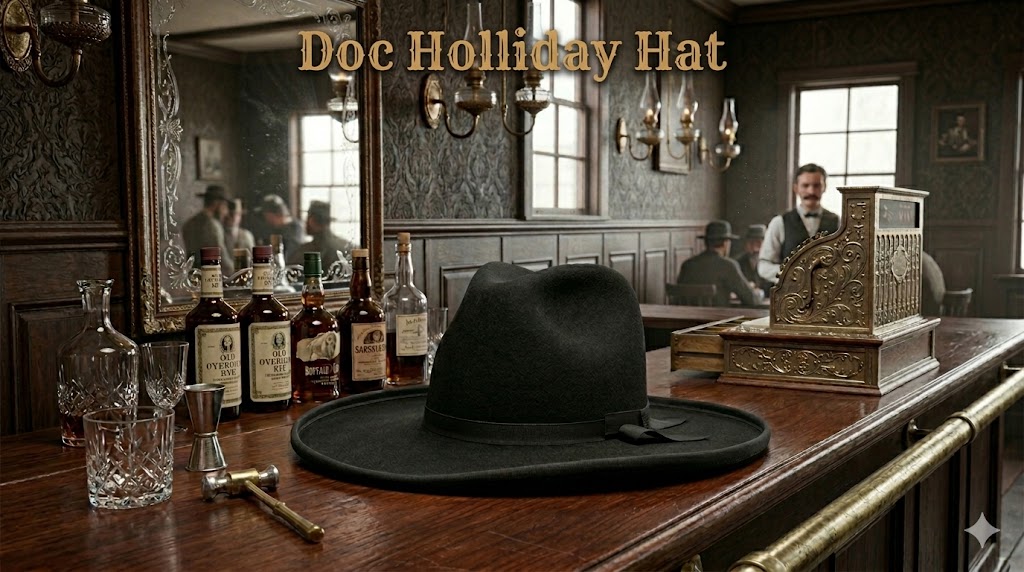
Picture a dimly lit saloon in Tombstone, Arizona, circa 1881. The air is thick with a suffocating blend of cheap cigar smoke, spilled rye whiskey, and the unmistakable, electric tension of men who live by the gun. At a corner faro table, a man sits, coughing softly into a silk handkerchief. He is lean, almost skeletal, yet elegantly dressed in a fine wool frock coat. But before you even lock eyes with his cold, unblinking gaze, your attention is drawn to the silhouette framing his face. Peering over a stack of silver dollars is a distinct, low-crowned, wide-brimmed piece of headwear. This isn't just any piece of frontier clothing. This is the iconic Doc Holliday Hat, an accessory that didn't just shield a legendary gambler’s eyes from the sun—it came to symbolize the ultimate blend of Southern sophistication and lethal Western grit. When we look back at the grand pantheon of Wild West icons, we often fixate on the hardware. We talk about Wyatt Earp’s Buntline Special or Billy the Kid’s Winchester. But the clothes made the man, especially when that man was John Henry "Doc" Holliday. Doc was an anomaly in the dirt-caked territories of Arizona. He was a classically trained dentist from Georgia, a man who quoted Latin, played classical piano, and possessed manners polished in the high society of the American South. Yet, a terminal diagnosis of tuberculosis drove him west, turning him into a nomadic gambler and one of the fastest, most calculated duelists the frontier had ever seen. The Doc Holliday Hat was the ultimate visual extension of this dual identity: Refined yet dangerous, formal yet completely functional on a windswept desert plain. Today, the fascination with this particular piece of Western history hasn't waned at all. In fact, custom hatters and historical re-enactors spend countless hours trying to capture the exact spirit of the original silhouette. But what exactly defines an authentic Doc Holliday Hat? How did a gentleman's hat from the late 19th century transform into an enduring symbol of outlaw Americana, and how do modern artisans recreate this masterpiece from scratch? Pour yourself a glass of bourbon, kick up your boots, and let’s take a deep dive into the history, style, and Meticulous craftsmanship behind this legendary brim.
The Man Behind the Brim: Who Was John Henry Holliday?
To understand the power of the Doc Holliday Hat, you have to understand the brilliant, tragic lightning bolt of a human being who wore it. Born in Georgia in 1851, John Henry Holliday was raised in the classical Southern tradition. He was highly educated, fluent in Latin and Greek, trained in classical piano, and possessed impeccable manners. He graduated from the Pennsylvania College of Dental Surgery as a certified Doctor of Dental Surgery, ready to carve out a comfortable upper-class existence. But fate had a cruel, coughing twist waiting in the wings. At twenty-two, Holliday was diagnosed with pulmonary tuberculosis—the same consumption that had taken his beloved mother. The doctors gave him months to live, recommending the dry, arid climates of the American West to ease his final days. John Henry packed up his instruments, his fine clothes, and his Southern honor, and headed west toward the setting sun. He didn't find a cure, but he found a second life.
His travels took him through Dallas, Denison, Trinidad, Las Vegas, and eventually to a dusty silver boomtown called Tombstone, Arizona. It was here that his fateful brotherhood with Wyatt Earp was cemented in history. When the Earp brothers found themselves outnumbered by the Clanton and McLaury cowboy faction, Doc didn't hesitate. On October 26, 1881, wearing his long grey overcoat and his distinct flat-topped hat, Holliday walked down toward the O.K. Corral.
Within thirty seconds of terrifying gunfire, his place in American mythology was permanently cemented.
If you are looking for the absolute zenith of historical accuracy and luxury, the Miller Doc Holliday Hat is universally recognized as the premier replica on the market. Miller Hats didn't just look at an old black-and-white photograph and guess the dimensions; they meticulously engineered their replica based on exhaustive historical data, vintage catalog specifications, and surviving examples from the era. The result is an heirloom-quality masterpiece that feels less like a modern hat and more like a time machine.
Unmatched Structural Proportions The magic of the Miller version lies in its flawless geometric harmony. The flat gambler crown is struck at the precise historical height, avoiding the bulky "stovepipe" look of lesser replicas. The brim features the exact sweeping pencil roll that defined the late 1800s gambler aesthetic. When you put it on, the hat balances beautifully, casting a subtle, enigmatic shadow right across the eyes—exactly how Doc would have wanted it when sitting across from a man holding a questionable poker hand.
Premium Fur Felt Composition
A hat is only as good as the material it’s born from. Miller constructs their replica from an incredibly high-grade fur-felt blend. This isn't cheap wool that goes limp at the first sign of a rainstorm; it is a dense, velvety, incredibly resilient fur felt that holds its shape beautifully while remaining remarkably soft to the touch. It breathes naturally, repels water, and ages with a stunning, rugged character that only gets better over decades of wear.
Exquisite Internal Finishing
True luxury is found where the eye doesn't always look. Inside the Miller replica, you'll find a premium, genuine sheepskin leather sweatband, hand-stitched to perfection. This ensures the hat molds comfortably to the unique contours of your skull over time. The interior is completely lined with a rich, protective silk satin liner that features historical branding, protecting the felt from hair oils while providing a beautiful, old-world touch every time you lift the hat from your head.
The Ancient Craft: How Fur Felt Hats Are Made
To truly appreciate a premium hat, one must understand the grueling, fascinating, and deeply traditional process of its creation. Felting is one of humankind's oldest textile arts, predating spinning and weaving by thousands of years. While modern technology has streamlined a few
steps, the creation of a high-end fur felt hat remains an intensive, hands-on craft requiring immense skill and patience.
Step 1: The Raw Material and the Blend
Unlike wool hats, which are made from sheep's sheared fleece, fur felt hats are made from the
under-fur of specific animals—primarily beaver, mink, wild hare, and rabbit. This under-fur is
uniquely suited for felting because each individual fiber is covered in microscopic, hook-like
scales. When exposed to moisture, heat, and friction, these scales lock together permanently.
The hatter begins by creating a specific blend of fur. The higher the percentage of beaver fur, the
more water-resistant, durable, and expensive the hat will be. This blend is thoroughly cleaned
and processed through a machine called a "willower," which separates the soft, usable under-fur
from any stiff guard hairs, leaving behind a cloud-like mass of incredibly soft fluff.
Step 2: Forming the Cone (The Body's Birth)
Next comes one of the most mesmerizing steps in the entire process: the forming machine. The
loose fur fluff is blown into a sealed chamber where a large, perforated copper cone sits spinning
slowly on a turntable. A powerful vacuum underneath sucks the air down through the holes in
the cone, pulling the airborne fur onto its outer surface.
An operator carefully guides the flow of fur, ensuring it deposits evenly across the cone—slightly
thicker at the base (which will become the brim) and thinner at the top (the future crown). Once
the fur has completely covered the cone, it is sprayed with hot water to knit the fibers
together loosely. The operator then carefully wraps the delicate, wet web of fur in burlap and submerges
it in a boiling water bath. At this stage, the hat body is massive—often three times the size of a
finished human head—and looks like an oversized elf hat.
Step 3: Felting, Shrinking, and Planking
The large, fragile fur cone must now be shrunk down to its final, dense size. This is a brutal,
physically demanding process known as "planking." The hat bodies are repeatedly rolled,
kneaded, dipped back into boiling water, and rolled again. This constant mechanical action,
combined with extreme heat and moisture, forces the microscopic scales on the fur fibers to
interlock tightly, causing the material to shrink dramatically while increasing its strength,
thickness, and density.
As the hat shrinks, the artisan constantly inspects it for uniform thickness. Once the felt has
reached its optimal density and size, it is no longer a loose collection of hairs; it has transformed
into a single, cohesive, completely seamless piece of incredibly tough fabric that can withstand
years of abuse.
Did You Know? The phrase "Mad as a Hatter" originated from the traditional hat-making
process in the 18th and 19th centuries. Hatters used a mercuric nitrate solution during the
felting process to soften the animal furs. Over years of breathing in these toxic mercury
fumes, artisans developed neurological damage, leading to tremors, mood swings, and
erratic behavior.
Step 4: Blocking and Shaping the Silhouette
Now that the dense felt body is ready, it must be forced into the actual shape of a hat. The cone is
pulled over a wooden block that matches the exact desired head size and crown shape. Using
steam to make the felt pliable, the hatter pulls, stretches, and ties the felt down over the block,
flattening the excess material outward to form the raw brim.
Once the crown is locked onto the block, the brim is placed into a "flanging" machine or worked
by hand with heavy, heated sandbags to press it perfectly flat or introduce the desired swoop and
curl. The hat is then allowed to dry completely, memory-locking the shape into the very DNA of
the fur felt.
Step 5: Pouncing, Finishing, and Trimming
When the hat comes off the drying blocks, it is rough and slightly fuzzy. To achieve that smooth,
velvety sheen that defines a premium piece, the hat undergoes "pouncing." The artisan spins the
hat on a lathe and uses increasingly fine sheets of sandpaper to shave down the microscopic
surface fuzz, creating an incredibly soft, uniform texture known as a "peach-skin" finish.
Finally, the hat moves to the trimming department. Here, the raw edge of the brim is trimmed to
its exact final width. The internal leather sweatband is sewn in by hand, the protective silk satin
lining is inserted, and the exterior grosgrain ribbon band and matching pencil-rolled brim
binding are meticulously stitched into place. After one final inspection and a blast of steam, a
true work of art is born.
Styling the Legend: How to Wear a Modern Outlaw Icon
The beauty of a high-quality gambler hat is its incredible versatility. You don't need to be wearing
a three-piece Victorian suit or carrying a hidden pocket watch to make it work in the modern era.
It has transcended its historical roots to become a bold, timeless fashion statement.
For a rugged, contemporary everyday look, pair your hat with a crisp, well-fitted denim or
chambray button-down shirt, a dark leather jacket, and dark-wash raw denim jeans. The clean,
structured lines of the flat crown add an instant air of deliberate, understated cool to an outfit
without feeling overly theatrical. If you want to lean a bit closer to Doc’s dapper historical roots,
it pairs brilliantly with a tailored wool overcoat, a sharp blazer, or a structured waistcoat. The key to pulling it off with confidence is simple: never treat it like a costume. Wear it with the same
casual, unbothered attitude that John Henry Holliday carried through the saloon doors of
Tombstone. It isn’t just a hat; it’s a mindset.
The Verdict: An Investment in American History
In a modern world dominated by fast fashion, disposable synthetic clothing, and mass-produced
baseball caps, there is something deeply grounding about owning a piece of genuine, old-world
craftsmanship. A premium fur felt hat is one of the few items you can purchase today that will
actively outlive you if cared for properly, accumulating stories, character, and a beautiful patina
Across decades of rain, sun, and adventure.
John Henry Holliday knew that his time on this earth was short, and he chose to live it with an
uncompromising commitment to style, loyalty, and defiance. When you place a flawlessly crafted
replica like the Miller Doc Holliday Hat onto your head, you aren't just shielding your eyes from
the elements—you are tipping your brim to a legendary American spirit. It is an investment in
history, an appreciation for a dying manufacturing art, and the ultimate tribute to the most
dapper outlaw the Wild West ever witnessed.
0 Comments