
Straw, Soul, and the Sun: The Legend
of the Boater Hat
A Journey Through the Craftsmanship of Miller Boater Hats
There is a specific sound that defines a summer afternoon in the late 19th century. It
isn’t the chirping of cicadas or the distant splash of a rowing oar—though those are
certainly part of the symphony. It is the rhythmic, hollow tock-tock of a stiff straw
brim hitting a wooden tabletop. It is the sound of the Boater hat.
If you close your eyes and imagine a barbershop quartet, a riverside picnic in 1920s
Oxford, or a political convention from the age of Jazz, you are seeing the Boater.
Known also as the 'skimmer' or the 'basher,' this flat-topped, stiff-brimmed
masterpiece is more than just headwear; it is a cultural icon. And when we talk
about the pinnacle of this craft today, the conversation inevitably turns to Miller
Boater Hats and the enduring legacy of Miller Felt Hats.
The Anatomy of a Legend: How a Boater is Born
To the uninitiated, a Boater looks simple. It’s a circle of straw, right? Wrong. The
construction of a high-quality Boater is a feat of engineering and patience. Unlike
the floppy Panama or the casual trilby, the Boater is structural. It is architectural. It
is, quite literally, hard-headed.
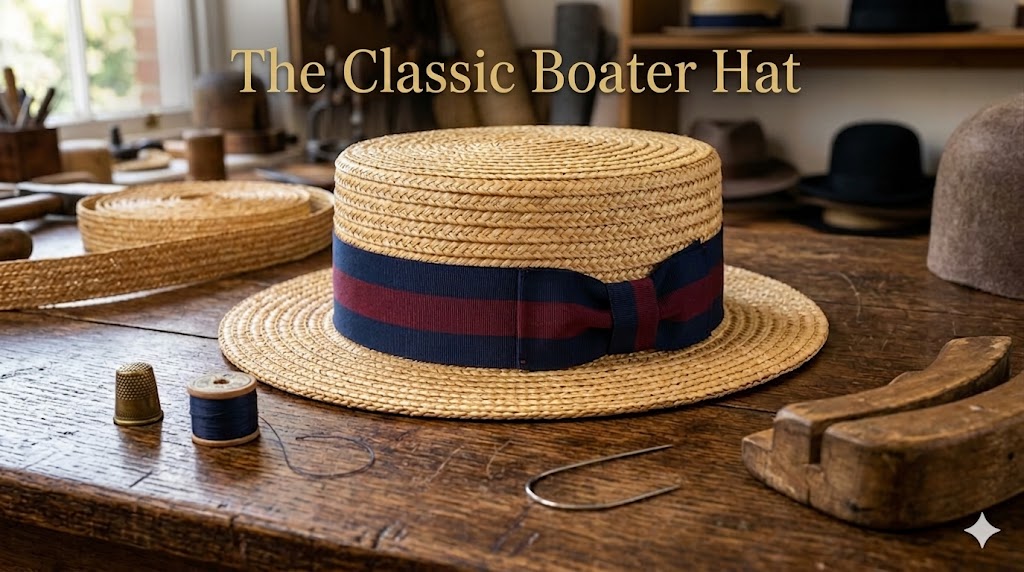
The process begins with the braid. Traditional boaters are made from Sennit straw
—a specific type of straw that is braided into long, flat ribbons. These ribbons aren't
just woven; they are meticulously sewn together in a spiral, starting from the center
of the crown and working outward. But the secret sauce? That’s the stiffening. To
achieve that signature "hard" feel, the straw is treated with a sizing agent
(historically a type of shellac) that turns the flexible grass into a rigid, durable shell.
This is where the true hatter’s skill comes into play. Creating Miller Boater Hats
requires a level of precision that modern mass-production simply can’t replicate.
Each hat must be blocked—stretched over a wooden mold—using heat and
moisture to set its shape. If the temperature is off by a few degrees, the straw
becomes brittle. If the tension isn't perfect, the brim will warp. A Miller hat is
defined by its crisp, sharp lines and its ability to hold that shape through years of
summer sun.
The Miller Touch: From Felt to Straw
You might wonder why a brand famous for Miller Felt Hats is so dominant in the
world of straw boaters. The answer lies in the heritage of the hatter. A master hatter
understands the "architecture of the head." Whether working with the soft,
luxurious beaver fur of a custom felt fedora or the rigid Sennit straw of a boater, the
goal is the same: balance, fit, and character.
The transition from the heavy, protective weight of Miller Felt Hats in the winter to
the breathable, defiant crispness of a Boater in the summer represents the seasonal
rhythm of the classic gentleman. Miller has carried over the techniques of the oldworld workshops—using hand-pressing and vintage machinery—to ensure that
their straw line carries the same weight of authority as their legendary felts.
"A boater is a statement of intent. It says: I am here to enjoy the day, but I haven't
forgotten my manners."
The Band: The Soul of the Skimmer
If the straw is the body of the Boater, the band is its soul. Traditionally, the Boater
hat band is a wide, grosgrain ribbon. But it isn’t just a decoration; historically, it was
a badge of identity. In the rowing clubs of the 1800s, the colors on your hat band
told the world which club you belonged to. Blue and white for one, crimson for
another.
When you browse Miller Boater Hats, you see this tradition alive and well. The
styles range from the classic "Collegiate" striped bands—evoking images of Ivy
League regattas—to the "Black Label" formal bands that turn a Boater into
something suitable for a summer wedding or a garden party. The bow is almost
always placed on the left, finished with a precise "hatter's knot" that remains flat
against the crown to maintain the hat’s aerodynamic profile.
The Golden Age of the 'Basher'
Why did the Boater become so popular? In the early 20th century, it was the
universal summer uniform. From 1880 to 1940, if you were a man and it was
between Memorial Day and Labor Day, you were wearing a Boater. It was the "Straw
Hat Day" tradition—a fixed date on the calendar when men would collectively
mothball their Miller Felt Hats and switch to straw.
It was democratic. It was worn by factory workers on their day off and by
billionaires on their yachts. It became the "Political Hat," famously waved in the air
during conventions to show support for a candidate. Icons like Maurice Chevalier
and Fred Astaire turned the Boater into a symbol of effortless charm. They wore it
tilted at a rakish angle—the "rakish cant"—which turned a stiff, formal object into a
tool of flirtation and charisma.
Why Choose a Miller?
In a world of fast fashion, why invest in Miller Boater Hats? Because a cheap
boater is a costume; a Miller boater is an heirloom. Cheap versions use paper-braid
or plastic-coated straw that yellows and cracks. A genuine Miller Felt Hats
production, even in straw, utilizes high-grade natural materials that breathe. When
you wear a real Boater, you feel the air circulating through the weave, keeping you
cool while the wide brim protects you from the glare.
THE HATTER'S CRAFT
The men and women behind these hats—the hatters—are a vanishing breed. To
make a Boater, they must manage the "stiffness" without making the hat
uncomfortable. A Miller hat features a high-quality leather sweatband, hand-sewn
inside, which acts as a buffer between the rigid straw and your forehead. This
ensures that while the hat looks like a piece of sculpture, it fits like a glove.
How to Wear It Today
You don't need a rowboat or a megaphone to pull off a Boater in the 2020s. The key
is confidence. Pair your Miller Boater Hats with a linen suit for a classic look, or
break the rules and wear it with a crisp white shirt and dark denim. It is a hat that
demands respect but rewards the wearer with an instant aura of "Old World" cool.
Whether you are a long-time collector of Miller Felt Hats looking to bridge the gap
into the warmer months, or a newcomer looking for that one piece of headwear
that will set you apart from the sea of baseball caps, the Boater is your answer. It is
history you can wear. It is a tribute to a time when getting dressed was an art form.
© 2024 The Hatter's Journal | Celebrating the Legacy of Miller Boater Hats & Miller Felt Hats
0 Comments