
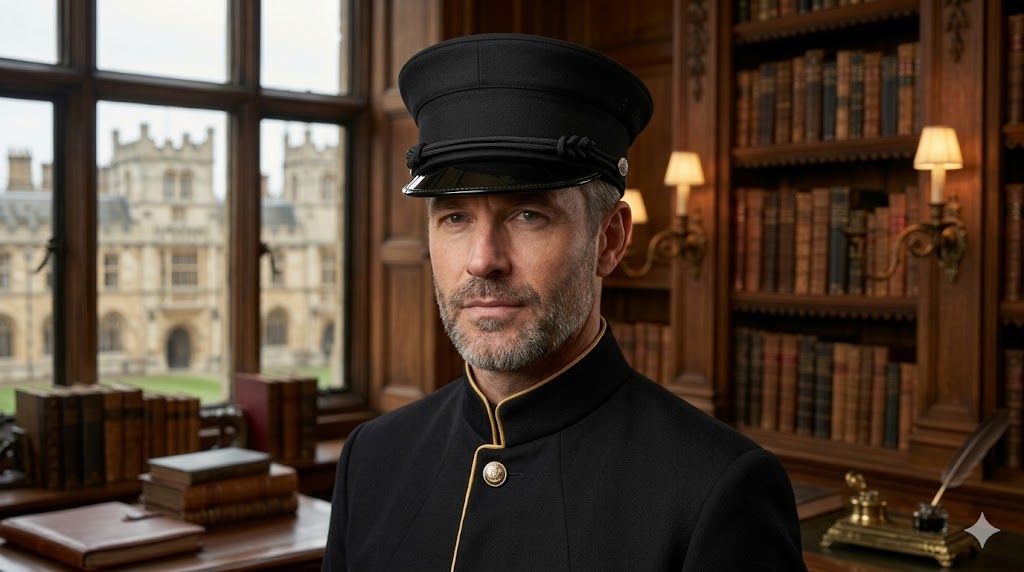
The Birth of the "Captain" of the Rails
In the mid-19th century, railroad employees didn’t have a standard uniform. Conductors often wore their own business suits and top hats. However, as rail travel expanded, passengers struggled to identify who was in charge.
By the 1870s and 1880s, major railroads began implementing strict dress codes. The conductor, often called the "Captain," needed a look that commanded.
Imagine, for a moment, that it’s 1855. You are standing on a dusty wooden platform in upstate New York, the air thick with the smell of coal smoke and anticipation. The iron horse—a puffing, screeching beast of steam and steel—clatters to a halt. You’ve got your ticket clutched in your hand, but there’s a problem.
The platform is a chaotic sea of people. Men in soot-stained overalls are shoveling coal; dandy gentlemen in silk waistcoats are flirting with ladies in hoop skirts; and various peddlers are shouting about miraculous tonics. You need to know if this is the express to Albany, but everyone looks like… well, everyone else.
Eventually, you tap a man in a rumpled frock coat and a battered top hat on the shoulder. He looks at you with utter disdain. He’s not the man in charge; he’s a disgruntled banker from Boston.
This was the wild, unregulated infancy of the American railroad. Before the brass buttons, before the crisp navy wool, and long before the legendary Captain Hats became the gold standard of authority, the railroad was a fashion free-for-all.
The Era of the "Civilian" Conductor
In the mid-19th century, the concept of a "uniform" was largely reserved for the military. If you worked for the railroad, you simply wore your best clothes—or at least the clothes you didn't mind getting covered in grease.
Conductors, the men responsible for the lives of hundreds of passengers and the punctuality of a multi-ton machine, usually donned standard business suits. They wore high-collared shirts, heavy overcoats, and almost always a top hat or a derby.
While this look said "I’m a professional," it didn't say "I’m the boss." In fact, many early conductors actively resisted the idea of a uniform. To them, wearing a prescribed outfit felt like "livery"—the clothes worn by servants or footmen. These were rugged individualists. They didn't want to look like they belonged to a company; they wanted to look like they belonged to themselves.
But as the rail networks stretched across the continent, the lack of a visual hierarchy became a logistical nightmare. Passengers were boarding the wrong cars, getting swindled by "train-jumpers" pretending to be staff, and generally feeling the anxiety of a system without a clear leader.
Enter the "Captain": A Change in Command
By the late 1860s and early 1870s, the mood began to shift. The Civil War had ended, and the American public had become accustomed to the visual language of military rank. People looked for brass, for stripes, and for structured headgear to tell them who was holding the reins of power.
Railroad executives realized that if they wanted to sell more tickets, they needed to sell "order." They began to borrow heavily from naval traditions. Just as a ship had a Captain, the train would have one too.
The conductor was no longer just a ticket-taker; he was the "Captain of the Rails." And every Captain needs his hat.
The Evolution of the Conductor Hat
The transition wasn't overnight. It started with subtle cues—perhaps a small brass badge pinned to a civilian lapel—but soon evolved into the full-scale regalia we recognize today. The history of conductor hats is really a history of industrial psychology.
1. The Early Pillbox (The Transition)
Before the iconic "brimmed" look took over, some lines experimented with pillbox-style hats. They were short, cylindrical, and featured the name of the railroad embroidered in gold or silver thread. While they were distinct, they lacked the "command" presence the industry was looking for.
2. The Influence of the Hatter
As demand grew, the role of the professional hatter became central to the railroad's brand. This wasn't a job for a generic garment factory. A conductor’s hat had to be reinforced to withstand the soot, wind, and constant handling.
Master hatters began using heavy wool felt and stiffened buckram to create a hat that wouldn't lose its shape. They added the "stiffener" to the crown, giving the hat a flat, authoritative top that sat parallel to the ground.
3. The Military Peak
The true breakthrough came when railroads adopted the "visored" or "peaked" cap, heavily inspired by the Captain hats worn by naval officers. The addition of a polished black leather (or patent leather) brim served two purposes:
- Function: It shielded the conductor’s eyes from the sun and the glare of the gleaming locomotive.
- Symbolism: It created a "frame" for the face, focusing the passenger's attention on the conductor's eyes and authority.
Anatomy of a Classic Captain Hat
By the 1880s, the "standard" look was set. If you were a passenger on the Pennsylvania Railroad or the Union Pacific, you looked for a specific set of features to find your Captain:
- The Crown: Usually flat or slightly sloped toward the back, made of navy blue or black serge wool.
- The Badge (The "Title"): A heavy brass or gold-plated plate prominently displaying the word CONDUCTOR. This was the centerpiece. It was the "North Star" for lost travelers.
- The Chin Strap: Often purely decorative by this point, but made of gold braided cord or flat leather, held in place by two small brass buttons embossed with the railroad’s logo.
- The Vents: Small metal grommets on the side to allow for airflow, because steaming across the Mojave Desert in a wool hat is no joke.
Why the "Captain" Label Stuck
There’s a reason we don't call them "Train Managers." The term "Captain" was a brilliant marketing move. Ships were the original long-distance luxury transport, and sea captains were legendary figures of absolute authority.
By dressing conductors in Captain hats, the railroads were subconsciously telling passengers: "You are safe. This man is a master of navigation. He is the law on this vessel."
The conductor hat became so synonymous with authority that it eventually trickled down into other professions. You started seeing similar silhouettes on police officers, fire chiefs, and airline pilots. But the railroad was the pioneer of the "Professional Peak."
The Hatter’s Craft: From Felt to Fame
The 1890s were the golden age of the hatter. Companies like Stetson and various specialized uniform tailors in Chicago and New York made a fortune off railroad contracts.
A conductor's hat was a point of immense pride. In many cases, the conductor had to pay for his own uniform, which meant he took meticulous care of it. He would use a soft brush to remove coal dust every night. He’d polish the brass badge until it shone like a beacon. To lose your hat was to lose your identity.
There are legendary stories of conductors chasing their hats down windy platforms, not because of the cost, but because stepping onto a train "headless" was considered a dereliction of duty. Without the hat, he was just a man. With the hat, he was the Captain.
Captain Hats in Modern Pop Culture
Today, the classic conductor-style Captain hat has transcended the tracks. It has become a symbol of vintage Americana, high fashion, and even rebellious subcultures.
- The Nostalgia Factor: We see the hat every year in The Polar Express, cementing its place as a symbol of magical, organized adventure.
- High Fashion: Designers periodically bring back the "mariner" or "conductor" silhouette, using the structured crown to add a touch of "bravo" to a runway look.
- The "Captain" Vibe: Whether it’s a yachting cap or a rail cap, the aesthetic remains the same: it’s the hat of someone who knows where they are going.
Why the Look Endures
We live in an era of casual Fridays and hoodies, yet the allure of the structured Captain hat remains. Why? Because there is something deeply comforting about a person in a well-made hat.
The conductor hat represents a time when travel was an event. It reminds us of a period when the person in charge took pride in their appearance, signaling to the world that they were ready for the responsibility of the journey.
The "Captain of the Rails" may have swapped steam for electricity and wool for blends, but the silhouette remains. It’s a crown of the common man—an icon of the industrial age that turned a simple railway employee into a legend of the high iron.
Fun Facts About Conductor Hats
| Feature | Historical Significance |
| Gold Cord | Usually designated a higher rank, like a Chief Conductor or Station Master. |
| Wicker Inserts | In the summer, some hatters used wicker frames inside the wool to allow better ventilation. |
| The "Pinch" | Older conductors would often develop a specific "pinch" in the front of the hat from years of tipping it to ladies. |
Finding Your Own Captain Hat
Whether you’re a history buff, a rail-fan, or someone looking to add a touch of "Captain" energy to your wardrobe, the legacy of the conductor hat is easy to find. Modern hatters still produce these classic silhouettes, often using the same patterns developed in the late 1800s.
When you put one on, you aren't just wearing headgear. You’re wearing 150 years of steam, steel, and the undeniable authority of the man who kept the world moving on time.
Next time you hear that "All aboard!" echoing down a platform, look for the peak of the cap. The Captain is still there, guarding the legacy of the rails.
Did the history of the railroad "Captain" change how you look at modern uniforms?nded respect. The resulting uniform was modeled after military and naval attire, with the cap as its crowning jewel.
0 Comments