
There is a moment in late-night television surfing, or deep-dive cinematic archaeology, where the modern world completely dissolves. It happens right around the time a low, rolling mist creeps out of the Sawtooth Mountains, swallowing an isolated mining camp in its pale clutches. Then, out of the haze, comes the rhythmic, ghostly clop of hooves. And then you see him.
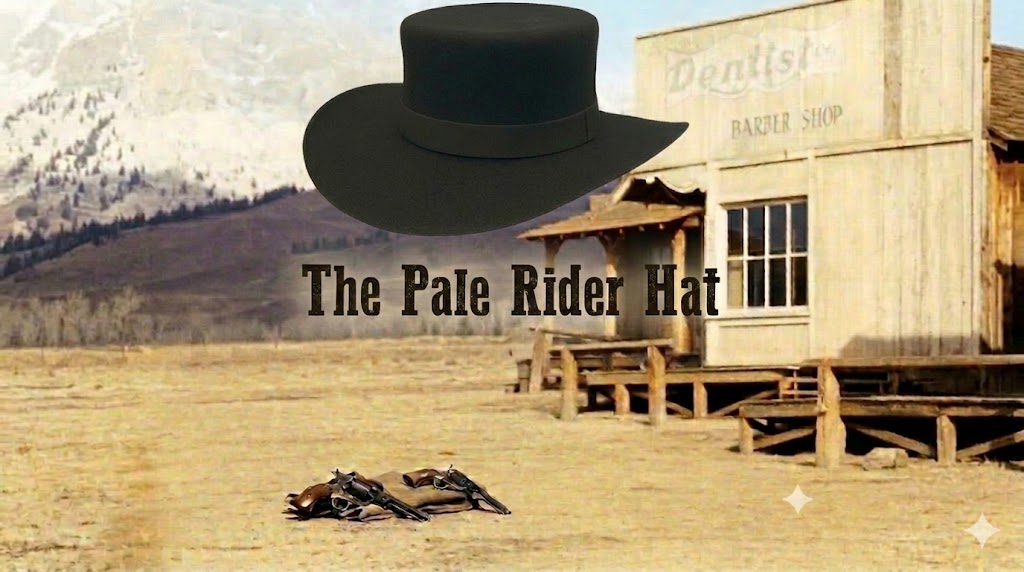
He isn’t wearing the sweat-stained, sun-bleached hat of a standard-issue cowboy hero. He isn’t sporting the pristine, stark-white headwear of a Hollywood white hat. Instead, he wears something that feels like it was pulled straight from the soil of an old graveyard: a short, flared crown, black, crown-creased masterpiece that casts an impenetrable shadow right across his steely eyes. We are talking, of course, about Clint Eastwood in Pale Rider (1985). More specifically, we are talking about the undisputed crowning achievement of that film’s wardrobe: the iconic Pale Rider Hat
For film buffs, Western purists, and custom hat collectors alike, that specific piece of headwear isn't just an accessory. It is a character in its own right. It’s an architectural statement of frontier justice, a dark halo for a vengeful spirit, and the ultimate template for what a custom Western hat should be. Today, we’re going on a long, dust-choked journey into the heart of California’s gold country, breaking down the cinematic brilliance of Eastwood’s mid-80s masterpiece and dissecting exactly why the legendary Miller Pale Rider Hat replica remains one of the most sought-after custom hats in the world. So, pour yourself two fingers of cheap whiskey, adjust your brim, and let’s ride into the high country..
To understand the magic of the Pale Rider Hat, you first have to understand the landscape into which it rode. By 1985, the traditional American Western wasn't just dead; it was practically a fossil. The golden age of John Ford, John Wayne, and studio-backed horse operas had evaporated into the neon-soaked, synth-heavy landscape of the mid-1980s. Audiences wanted musclebound heroes with automatic weapons or teenagers in time-traveling Deloreans. Nobody was looking for a slow-burn, atmospheric Western about corporate greed, panning for gold, and biblical allegories.
Nobody except Clint Eastwood.
Eastwood, who had already permanently redefined the genre in the 1960s with Sergio Leone’s Dollars Trilogy and later with his own directorial efforts like High Plains Drifter (1973) and The Outlaw Josey Wales (1976), knew that the Western didn't need to be modernized—it needed to be mythologized.
Enter Pale Rider.
The plot is deceptively simple, echoing the classic framework of Shane (1953), but injected with a heavy dose of Gothic horror and supernatural dread. A community of humble, hard-working hydraulic gold miners (known as "tin-panners") in Lahood, California, is being brutally terrorized by a ruthless, corporate mining magnate named Coy LaHood. LaHood wants their land, and he’s using everything from thugs to corrupted lawmen to blast, burn, and bleed them out.
When a young girl named Megan Wheeler prays for a miracle over the grave of her murdered dog, quoting the Book of Revelation ("And I looked, and behold a pale horse: and his name that sat on him was Death, and Hell followed with him"), the universe answers.
Out of the mountains rides a stranger. He wears a clerical collar, earning him the moniker "The Preacher." But despite his holy vestments, he carries himself with the quiet, terrifying lethalness of an avenging angel. He doesn’t talk much. He doesn’t need to. His presence fills the frame, and his silhouette is anchored by that magnificent, high-crowned, dark brimmed hat.
What makes a piece of wardrobe cross over from "costume" into "legend"? It's all in the details, the silhouette, and the way it catches the light—or, in this case, the way it blocks it out.
The Pale Rider Hat is a fascinating departure from Eastwood's previous cinematic headwear. In his Spaghetti Western days as the "Man with No Name," he wore a lower, flat-crowned, tan/brown hat with a distinctly pinched front and a leather band—a look that screamed gritty, sun-baked pragmatism. In High Plains Drifter, his hat was darker, wider, and more sinister. But in Pale Rider, Eastwood and his costume design team went for pure, towering theatricality.
Let's break down the anatomical blueprint of what makes a true Pale Rider Hat:
The most striking element of the hat is its height. It features a tall, un-pinched, square-ish crown that sits significantly higher than modern cowboy hats. It utilizes a soft, center-fire or telescope-adjacent crease that gives it an elongated, imposing look. When Eastwood stands in the doorway of a miner's cabin, the crown almost touches the timber rafters. This wasn't accidental; it was designed to make him look taller, more imposing, and fundamentally otherworldly.
One of the greatest debates among Western hat historians is the exact color of the original film prop. Depending on the scene—whether it's under the harsh, white sun of the California panning streams or the dim, amber glow of a kerosene lamp—the hat shifts colors. It is generally recognized as a deep, distressed charcoal grey or a very dark, muddy chocolate brown. It’s an earthy, somber tone that matches his long, flowing burgundy duster coat, creating a color palette that screams "funeral director of the old West."
The brim of the Pale Rider Hat isn't heavily curved up at the sides like a modern rodeo hat. Instead, it features a classic, raw-edge, flat frontier brim with a very subtle, menacing dip in both the front and the back. This swooping dip acts like a visor, perfectly engineering a permanent shadow across Eastwood's eyes. It forces the audience to focus on his jawline and those famous, squinting eyes peering out from beneath a ledge of dark felt.
While some Western heroes favor flashy silver conchos, braided horsehair, or snake skins around their crowns, the Preacher keeps it intensely understated. The original hat features a simple, thin, dark leather or grosgrain band that matches the color of the felt, secured with a small, unpretentious buckle or knot. It doesn't scream for attention; it lets the shape of the hat do all the talking.
The Custom Legacy – The Miller Pale Rider Hat
Because the movie became an instant classic, cementing itself as the bridge between old-school Westerns and Eastwood’s eventual magnum opus Unforgiven (1992), gearheads and Western reenactors immediately began hunting for a way to replicate the look.
But you couldn't just walk into a standard western wear store in 1985 and buy a hat like that off the rack. It required a master hatter’s touch. It required custom blocking, specific fur-felt blending, and hand-shaping.
This is where the legendary Miller Pale Rider Hat enters the chat.
For decades, custom hat makers have tried to capture the exact spirit of the Preacher's hat, but few have achieved the widespread acclaim and historical accuracy of the artisans who specialize in recreating historical film pieces. When a modern cowboy or collector looks for an authentic replica, they look for a hatter who understands that a Pale Rider Hat isn't just about measurements; it's about attitude.
If you are looking to invest in a premium replica, like those inspired by the iconic Miller style, you aren't just buying wool or felt. You are buying a piece of functional art. Here is what separates a cheap costume piece from a high-end, custom-crafted Pale Rider Hat:
- The Fur Felt Blend: Cheap hats use wool, which loses its shape the moment it gets caught in a mountain rainstorm. A true custom replica uses a high-grade fur felt blend (often ranging from 10X to 100X beaver fur). Beaver fur is naturally water-repellent, incredibly durable, and holds a crisp, hand-shaped crease for decades.
- The Weathering and Distressing: In the film, the Preacher didn't look like he just bought his gear at a dry goods store. His hat had dust in the seams, slight sweat stains on the crown, and the subtle wear-and-tear of a man who rides through wind, rain, and gunsmoke. Master custom hatters use specialized hand-aging techniques—using real dirt, fire, and wire brushes—to give the hat that authentic, "lived-in" frontier grit right out of the box.
- Tailored Fit: A hat with a crown that tall will fly off your head the moment your horse hits a gallop if it doesn't fit perfectly. Custom hatters build the hat to the exact circumference and oval shape of your head, ensuring it sits low and tight, just like Clint wore it.
Let’s face it: rocking a hat with this much cinematic gravity takes serious confidence. If you walk into a local steakhouse or a casual Friday at the office wearing a tall-crowned, charcoal-grey Preacher hat, people are going to notice.
But there is a fine line between looking like a rugged connoisseur of Western style and looking like you're lost on your way to a Halloween party. Here is how to incorporate the timeless aesthetic of the Pale Rider Hat into a modern wardrobe:
The "Modern Frontier" Look
You don't need a flowing burgundy duster coat to make this hat work. Pair a dark charcoal or chocolate brown Pale Rider Hat with a well-fitted, dark denim button-down shirt or a rugged canvas utility jacket. Keep the colors muted—think slate greys, deep olives, earth tones, and blacks. The dark, high crown of the hat acts as the ultimate statement piece, so keep the rest of your outfit clean, rugged, and minimalist.
The Footwear Match
Never wear a high-end custom Western hat with sneakers. It’s a stylistic sin. If you're rocking a hat inspired by Clint's iconic look, ground your outfit with a serious pair of leather boots. They don't have to be cowboy boots with riding heels; a pair of rugged, well-patinated service boots or Chelsea boots in dark brown or black leather will bridge the gap between frontier ruggedness and urban sophistication perfectly.
Own the Shadow
The most critical asset to wearing a Pale Rider Hat isn't clothing at all—it's posture. This hat was designed for a man who stands tall, looks people dead in the eye, and speaks only when necessary. Wear it low on your brow. Let that subtle brim-dip do its job and cast a little mystery over your eyes.
To truly appreciate why we are still talking about this hat over forty years after the film's release, we have to look at how Eastwood used it as a tool for visual storytelling.
In Pale Rider, the hat is more than shelter from the elements; it is a spiritual barrier. Throughout the film, Clint Eastwood uses the brim to control exactly how much of his humanity the audience—and the other characters—are allowed to see.
Think about the iconic scene where the Preacher first enters the town of LaHood. The camera stays low, looking up at him. The towering crown of his hat frames him against the sky, making him look like a monument. We can't see his eyes; we only see the glint of his jaw and the badge of his clerical collar. He is an enigma, a blank slate of vengeance upon which the desperate miners can write their hopes, and the corrupt mining bosses can write their fears.
Compare that to the quiet, intimate moments he shares with Sarah Wheeler, the lonely mother of the camp. Inside the soft, warm light of her cabin, the hat comes off. The shadow disappears. Suddenly, we see the lines of exhaustion on Eastwood’s face, the deep-seated sorrow in his eyes, and the vulnerability of a man who knows his time on this earth is fleeting.
And then, when the final battle looms and the corrupt Marshal Stockburn arrives in town with his six pinkerton-style assassins, the hat goes right back on. It is his battle helmet. As he stalks through the deserted, dusty streets of the mining town, systematically dismantling Stockburn’s men, the Pale Rider Hat remains firmly planted, a dark, immovable omen of impending doom for the wicked.
Cinematic trends come and go. The flashy, over-the-top action heroes of the 1980s have mostly faded into nostalgia, replaced by capes, CGI, and spandex. Yet, the imagery of Pale Rider remains as sharp, striking, and relevant today as it did in 1985.
Why? Because true style, rooted in myth and crafted with perfection, never goes out of fashion.
The Pale Rider Hat represents the absolute apex of Clint Eastwood's Western aesthetics. It is a masterclass in how wardrobe can elevate a film from a simple story into an enduring piece of American folklore. It reminds us of a time when heroes were mysterious, justice was hard-fought, and a man’s hat told you everything you needed to know about his soul before he ever said a word.
Whether you are a die-hard cinema buff who rewatches the film every autumn, a Western lifestyle enthusiast looking to upgrade your collection, or someone searching for the ultimate custom replica like the historic Miller Pale Rider Hat, this iconic design offers something timeless. It’s more than just felt, leather, and a crown crease. It’s an invitation to step out of the chaotic rush of the modern world, step into the quiet mystery of the high country, and ride your own trail.
So, here’s to the Preacher, to the pale horse he rode in on, and to the legendary Pale Rider Hat that continues to cast its long, beautiful shadow over the history of the silver screen.
0 Comments