
There’s something about a well-made felt hat that carries the quiet authority of time. It doesn’t shout. It doesn’t need to. Like a seasoned ranch hand leaning on a cedar fence at dusk, it speaks through presence alone. A good felt hat has weight, character, and a story stitched into every fiber. And behind that hat—whether it crowns a cattleman, a craftsman, or a gentleman strolling a Santa Fe plaza—lies one of the oldest and most fascinating crafts still alive today: felt making.
This is not factory fluff and fast fashion. This is alchemy. Fur turned into fabric without weaving or knitting. Steam, pressure, and patience transforming loose fibers into something that can outlast its maker. If you’ve ever worn a proper felt hat and wondered why it feels alive in your hands, you’re already sensing the mystery.
Let’s step into that world.
Where It All Began: Ancient Craft, Enduring Legacy
Felt predates woven cloth by thousands of years. Long before looms clattered in villages, nomadic people across Central Asia were rolling wool into dense, weatherproof material for tents, blankets, and clothing. The process was simple in principle: heat, moisture, and agitation bind fibers together. But simple doesn’t mean easy.
By the time felt reached Europe, it had evolved into something finer—especially in the form of hats. Beaver felt, in particular, became prized for its durability and water resistance. In fact, the demand for beaver pelts shaped trade routes, economies, and even conflicts in North America.
The men’s felt hat—whether a wide-brimmed western or a sharp fedora—stands on the shoulders of that long history. When you pick one up, you’re holding a piece of that lineage.
What Felt Really Is: Not Woven, Not Knitted—But Locked Together
At its core, felt is made from animal fibers—traditionally beaver, rabbit, or hare fur—that have microscopic barbs along each strand. Under heat and pressure, these barbs interlock like a thousand tiny hooks.
No threads. No weaving. Just nature doing what it was designed to do.
That’s the secret behind felt’s unique properties:
- Water resistance (it sheds rain like a duck’s back)
- Shape memory (it holds a crease but can be reshaped)
- Durability (a good hat can last decades)
- Warmth without weight
Beaver felt sits at the top of the mountain. It’s finer, tighter, and more resilient than rabbit or wool. That’s why the old-timers prized it, and why high-end hats still carry that reputation today.
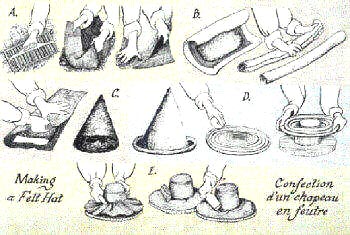
From Fur to Hat: The Felting Process Step by Step
Now here’s where the craft turns into something almost ritualistic.
1. Blending the Fur
Different furs are mixed depending on the desired quality. A high-end hat might use a heavy percentage of beaver, while more affordable hats lean on rabbit or blends.
2. Forming the “Hood”
Loose fur is blown onto a cone-shaped mold, forming a fragile web called a “hood.” At this stage, it barely holds together.
3. Felting Through Heat and Moisture
Hot water and steam are introduced, and the fibers begin to shrink and lock. The hood is repeatedly worked, shrunk, and hardened. What starts oversized gradually tightens into dense felt.
4. Fulling and Shrinking
The material is compressed further, often shrinking dramatically. This step builds strength and density—the backbone of a quality hat.
5. Blocking
The felt is stretched over wooden hat blocks to form the crown and brim. This is where personality enters the picture. The same raw felt can become a cattleman’s crease, a gambler’s crown, or a fedora with a snap brim.
6. Pouncing
This is one of the most overlooked steps. The surface is sanded—sometimes repeatedly—to create that smooth, almost suede-like finish. Done right, it feels like velvet under your fingertips.
7. Finishing Touches
Bands, liners, sweatbands, and final shaping bring the hat to life.
By the end, what began as loose fur has become something structured, durable, and deeply personal.
The Hat as a Tool, Not Just Style
Out West, a felt hat isn’t decoration. It’s equipment.
A proper felt hat will:
- Turn a cold rainstorm
- Shade your eyes in hard sun
- Hold its shape after years of use
- Take a beating and still look right
That’s why ranchers and outdoorsmen have trusted felt for generations. It’s built for weather, not just for show.
Even in town, a felt hat carries that same DNA. A good fedora or western hat doesn’t just sit on your head—it frames your presence. It tells people you understand something about quality, about patience, about things made to last.
The Quiet Differences: Wool vs. Fur Felt
Not all felt is created equal, and a seasoned hand can tell the difference in seconds.
Wool Felt
- Softer, less durable
- Loses shape more easily
- More affordable
- Good for occasional wear
Fur Felt (Rabbit, Hare, Beaver)
- Denser and stronger
- Holds shape in rain and heat
- Can be reshaped with steam
- Ages gracefully
Beaver Felt (Gold Standard)
- Exceptional water resistance
- Long lifespan
- Smooth, refined finish
- Premium price, but earned
There’s an old saying among hat makers: “You buy wool once. You buy beaver for life.” It’s not far from the truth.
The Role of the Hat Maker: Craft Meets Judgment
A machine can make a hat. But it takes a craftsman to make a good one.
Blocking, shaping, and finishing require an experienced eye. Too much pressure and the felt stiffens. Too little and it lacks structure. Even the angle of a brim or the depth of a crease can change how a hat sits and feels.
The best hat makers work like quiet sculptors. Steam rises, hands move, and something takes form that wasn’t there before.
It’s part skill, part instinct.
The Mystery: Why Felt Feels Alive
Here’s where things step beyond mechanics.
A well-made felt hat doesn’t feel like dead material. It responds. It adapts. It seems to remember.
You wear it in the rain, and it tightens slightly. You reshape it with steam, and it accepts the change. Over time, it takes on the subtle imprint of its owner.
That’s the mystery.
It’s not just that the fibers lock together. It’s that they remain flexible enough to evolve. The hat becomes a quiet companion, shaped not only by the maker—but by the miles you put under it.
Choosing the Right Felt Hat: A Practical Guide
If you’re standing at a counter or browsing online, here’s what matters:
1. Feel the Density
A quality felt hat should feel firm but not stiff. It should have body without brittleness.
2. Look at the Finish
The surface should be smooth and even. High-end hats have a refined, almost buttery finish.
3. Test the Shape
Gently press the crown. It should spring back without collapsing.
4. Consider the Use
- Ranch work or outdoor use → heavier felt, wider brim
- Town wear → lighter felt, refined shape
5. Invest Wisely
A good felt hat isn’t cheap—but it’s one of the few things you’ll own that improves with age.
Care and Stewardship: Keeping a Hat for a Lifetime
A felt hat rewards proper care.
- Brush it regularly to remove dust
- Keep it dry, but don’t fear light rain
- Use steam to reshape when needed
- Store it properly on a hat stand or upside down on the crown
Treat it right, and it’ll outlast boots, coats, and maybe even trucks.
A Hat with a Story
There’s a reason felt hats haven’t faded away, even as everything else has sped up and thinned out.
They belong to a slower rhythm. A time when things were made with care and meant to endure.
Out on a windy ridge, along a desert trail, or walking a quiet street at sunset, a felt hat feels at home. It doesn’t chase trends. It stands its ground.
And maybe that’s the real secret behind the craft.
Felt making isn’t just about binding fibers together. It’s about shaping something that can carry a life’s worth of weather, work, and memory.
Put on a good one, and you’ll understand.
It’s not just a hat.
It’s a companion.
0 Comments