
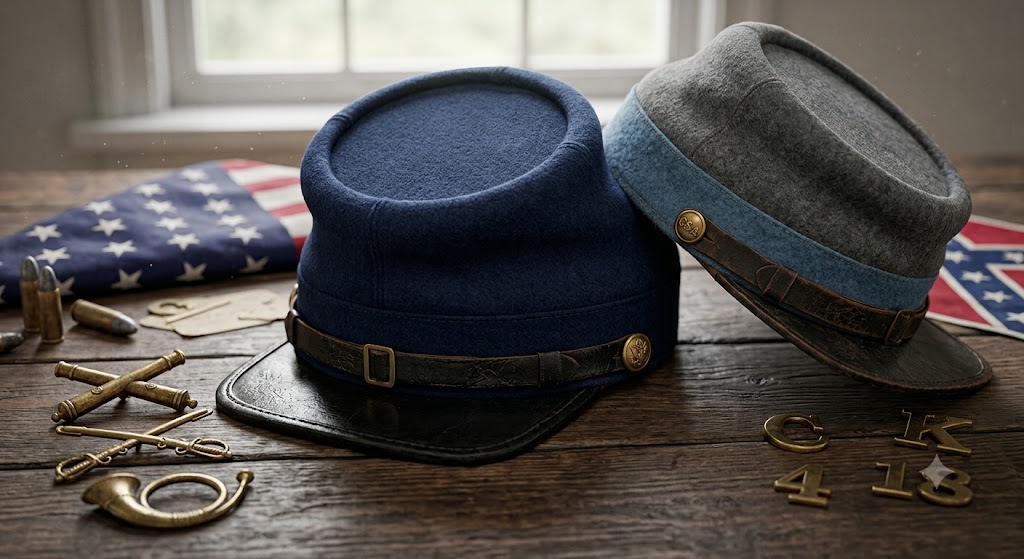
The Fabric of Fractured Echoes: A Narrative Journey Through Miller Civil War Hats
The wind over the Ridge did not care about the color of a man’s coat. It blew with the same biting, indifferent chill across the neat blue lines of the federal encampment as it did through the ragged, smoke-stained gray pickets a mere half-mile away. But if you were a soldier sitting by those flickering fires in the winter of 1862, identity wasn't just a political abstraction. It was something you wore on your head.
To understand the American Civil War, one must look at its hats. They were not mere uniform accessories; they were shelters, status symbols, foraging baskets, and distinct markers of an ideology. Today, walking into the modern world of historical reenactment, living history, or high-end collection, that visceral connection to the past is kept alive by masterful craftsmanship. For those who seek to feel the weight of that era, Miller Civil War Hats stand as a pinnacle of historical dedication, stitching the fragmented memories of Union and Confederate soldiers back into tangible reality.
Part I: The Crowns of a Divided Nation
To appreciate why Miller Civil War Hats are crafted with such meticulous attention to detail, we have to slip backward through time, past the asphalt and the power lines, into an era dominated by wool, leather, and black powder smoke.
Imagine stepping onto a muddy road in Virginia. If you looked at a passing regiment, their headgear told an immediate story of their origin, their branch of service, and how long they had been marching.
The Forage Cap and the Kepi: A Tale of Two Caps
The general public often lumps all Civil War caps into one category, but the soldiers knew better.
- The Forage Cap (The "Bummer"): This was the workhorse of the Union army. Descended from the 1851 fatigue cap, it featured a slouchy, sagging wool crown that leaned forward over a stiff leather visor. It wasn't glamorous. In fact, it looked distinctly unheroic. But it was immensely practical. Soldiers quickly realized the loose crown of the "bummer" could be stuffed with gathered blackberries, wild onions, fresh eggs, or extra hardtack during long marches.
- The Kepi: Sweeping in from French military fashion (the chasseur cap), the kepi was a tighter, more tailored design. It featured a sunken, circular top that slanted sharply down toward the front. While common among regular infantry on both sides, the kepi became a particular favorite of officers and high-ranking officials who wanted a sharper, more disciplined silhouette on the battlefield.
The Bold Silhouette of the Slouch and the Hardee
Away from the cramped confines of the Eastern Theater's trenches, out in the dusty expanses of the Western campaigns, soft caps gave way to wide brims.
The Hardee Hat, officially the Model 1858 Dress Hat, was the regulation headgear for the Union Army. It was a towering piece of stiff black felt, its brim pinned up on one side with a brass eagle—the left side for infantry, the right for cavalry, ensuring a soldier's rifle or saber wouldn't strike the edge during a drill. Adorned with long ostrich plumes and brass insignia, it was magnificent, heavy, and universally despised by regular grunts for being hot and cumbersome in the field.
The response? The Slouch Hat. Soldiers on both sides, but predominantly Confederates, abandoned the stiff regulations for civilian-style felt slouch hats. They could break the sun, channel the rain away from the neck, and be battered into whatever personalized shape the wearer desired.
Part II: Crafting History with Miller Civil War Hats
For a modern reenactor, historic theater actor, or passionate collector, a cheap costume prop from a party store is a betrayal of the narrative. True immersion requires authenticity you can feel when you lift the brim. This is where the heritage of Miller Civil War Hats enters the story.
Based in Houston, Texas, Miller Hats has built a reputation as a leader in premium, historically conscious headwear. Their Miller Civil War hats are built on a simple foundation: respect for original specifications and premium materials that stand up to modern use.
When you handle a premium piece from their collection, the difference lies in the tangible details:
- Premium Melton Wool: The caps are constructed using high-grade, heavy wool that mimics the texture, weight, and weatherproofing qualities of mid-19th-century textiles.
- Genuine Leather Elements: Visors and brims aren't plastic or cheap synthetic substitutes. They feature heavy, authentic leather pieces designed to age beautifully, taking on a natural patina over time.
- Functional Appointments: From working leather chinstraps equipped with brass center buckles to accurate internal leather sweatbands, these hats are built to be worn, not just displayed.
Whether you are portraying an enlisted private enduring the mud of Fredericksburg or an artillery officer directing a battery at Gettysburg, the foundational piece of your kit starts with the correct silhouette.
Part III: Blue and Gray — The Specifics of Miller Uniform Hats
The hallmark of the Miller Civil War Hats catalog is its targeted split between the Union and the Confederacy. They understand that a hat isn't just a hat; it is a repository of specific military regulations and cultural improvisation.
The Federal Standard: Miller Hats Union Collection
For those stepping into the shoes of the Federal army, uniformity and mass production were the names of the game. The Union supply chains were formidable, churning out crisp navy blue wool by the mile.
A Union Kepi from Miller Hats captures the industrial precision of the Northern war machine. The deep navy wool sits taut against the internal lining. The crown slants forward precisely, and the brass side buttons display the crisp stamped relief of the Federal Eagle.
For specialized impressions, Miller offers variations like the US Kepi - Artillery. This instantly identifies the wearer as a member of a big-gun crew, adding an invaluable layer of visual storytelling to a living history setup.
The Rebellion's Variety: Miller Hats Confederate Collection
To portray a Confederate soldier is to embrace a completely different narrative energy. Supply shortages, blockades, and a lack of manufacturing infrastructure plagued the Southern war effort. Uniforms varied wildly from depot to depot, creating a mosaic of grays, browns, and blues.
The Confederate line of Miller Civil War Hats honors this complex history. Their Rebel Kepis and caps are offered in the iconic medium gray wool, capturing the classic look of the Army of Northern Virginia.
- The CSA Buttons: Instead of the Federal Eagle, the functional chinstrap is anchored by stamped brass buttons proudly displaying the "CSA" monogram.
- Branch-of-Service Diversity: Just like their Northern counterparts, Confederate kepis featured colorful indicators for different branches. An infantryman might wear a sky-blue band, while a cavalry trooper boasted a yellow trim. Miller’s inventory allows reenactors to pinpoint these exact designations.
- The Slouch and Cavalry Styles: Because Southern troops frequently brought their own headgear from home or modified issued gear to survive the scorching Southern climate, Miller’s high-quality felt slouch hats and cavalry styles are perfect for capturing that rugged, individualistic Confederate look.
Part IV: The Anatomy of a Badge — Branch Colors and Insignia
A Civil War hat was a blank canvas that shouted a soldier's identity to his comrades amidst the blinding fog of black powder smoke. Once you select a foundational Union or Confederate piece from Miller Civil War Hats, the true personalization begins through branch colors and stamped brass insignias.
During the conflict, the United States and Confederate military departments utilized a strict color-coded system to identify a soldier's role on the battlefield.
The Color Code of the Line
- French Blue / Sky Blue: The color of the hard-marching Infantry. These were the men who held the lines, charged the stone walls, and bore the brunt of the casualties.
- Red: The mark of the Artillery. These soldiers handled the deadly Napoleonic smoothbores and Parrott rifles, their uniform bands reflecting the fiery flash of their cannons.
- Yellow: The flash of the Cavalry. Operating as the eyes and ears of the army, cavalrymen rode deep into enemy territory, requiring durable brimmed hats or sharp kepis that stayed secure during hard gallops.
- Buff / Cream: Reserved for General Staff and Engineers, the men who drew the maps, built the pontoon bridges, and directed the macro-strategy of campaigns.
- Black: The solemn indicator of the Medical Corps and Chaplains, moving through the aftermath to mend what the other branches had broken.
Stamped Brass Insignias
To complete a Miller Civil War Hats setup, historical enthusiasts turn to stamped brass insignia plates. These badges were typically attached to the top crown of a kepi or the front face of a forage cap using thin wire backings.
The most common variant was the M1851 Enlisted Hat Insignia. Stamped from brass dies that mirror the originals, these badges feature unmistakable symbols:
- Crossed Muskets for the Infantry.
- Crossed Cannons for the Artillery.
- Crossed Sabers for the Cavalry.
- A Hunting Horn for traditional light infantry units.
To add a final touch of granular realism, soldiers would frequently add an M1851 Company Letter (such as a brass 'A', 'B', or 'K') or regimental numbers directly above or below their branch insignia. Walking onto a reenactment field with a properly appointed Miller cap means an observer can read your hat like a book, instantly identifying you as a Private in Company C of the 4th Virginia, or a Corporal in the 2nd New York Artillery.
Part V: From the Trenches to the Screen — The Modern Legacy
Why does this matter? Why do we continue to meticulously analyze the slant of a leather visor or the specific weave of gray wool more than a century and a half after the last guns fell silent at Appomattox?
It is because history is not passive. It isn't confined to the flat, dusty pages of a textbook or the silent, glass-encased displays of a museum. History is alive when it is re-enacted. It breathes when a living historian stands in a freezing morning mist, feeling the chill bite through a wool coat, holding a heavy rifle-musket, and adjusting the brim of a forage cap.
This is the exact arena where Miller Civil War Hats serve their true purpose. Reenactment groups nationwide rely on these hats because they combine modern manufacturing with historical accuracy. They are designed to withstand the rain of a sudden weekend downpour at a mock encampment, the sweat of a long march across an open meadow, and the soot of black powder discharges—all while maintaining the authentic structural silhouette required by rigorous authenticity standards.
Part VI: Choosing Your Piece of the Past
If you're preparing to dive into Civil War history or looking to upgrade your current impression, choosing the right headgear is your most important decision. Your hat frames your face; it is the first thing people see when they look at your uniform.
Here is a quick reference guide to help you choose the right style from the Miller Civil War Hats collection based on your historical objectives:
1. The Enlisted Impression
If you want to represent the average, everyday soldier who did the heavy lifting of the war, look no further than the standard Union Forage Cap or a plain Confederate Kepi in medium gray. Keep it untrimmed and raw. Let the leather brim take on your fingerprints, and let the wool settle naturally. This represents the thousands of men who slept under the stars and cooked hardtack over open flames.
2. The Specialist or Officer
If your character has a bit of flair—perhaps a young lieutenant of a cavalry troop or an experienced sergeant of a Pennsylvania artillery battery—opt for a Miller Kepi with branch-specific colored bands (yellow for cavalry, red for artillery). Accent the crown with a crisp, wire-backed brass insignia. This setup speaks of responsibility, command, and the distinct pride of specialized corps.
3. The Campaigner
For an impression that captures the grit of the Western Theater—think Sherman’s march or the fierce, fluid movements of the Tennessee campaigns—a high-quality Felt Slouch Hat is unmatched. It breaks away from rigid European-style military uniforms and embraces the rugged, pragmatic American spirit that defined the armies moving through the heart of the continent.
The Lasting Echo
When you look closely at an old sepia-toned tintype photograph from the 1860s, the eyes of the soldiers always draw you in first. They look out across the decades with a haunting clarity. But right above those eyes sits the hat—battered, creased, swept with dust, or cocked at a defiant angle. It was a soldier's constant companion through the defining trial of the American landscape.
Investing in a piece from the Miller Civil War Hats lineup isn't just about purchasing apparel. It’s an act of historical preservation. It’s an appreciation for the details that mattered to the men who wore the blue and the gray. By maintaining those exact cuts, using those authentic wool weights, and anchoring them with true leather and brass, we ensure that when the stories of those fractured echoes are retold, they are told with the dignity, accuracy, and respect they deserve.
0 Comments